The Desolation
Bu madde henüz yalnızca İngilizce.
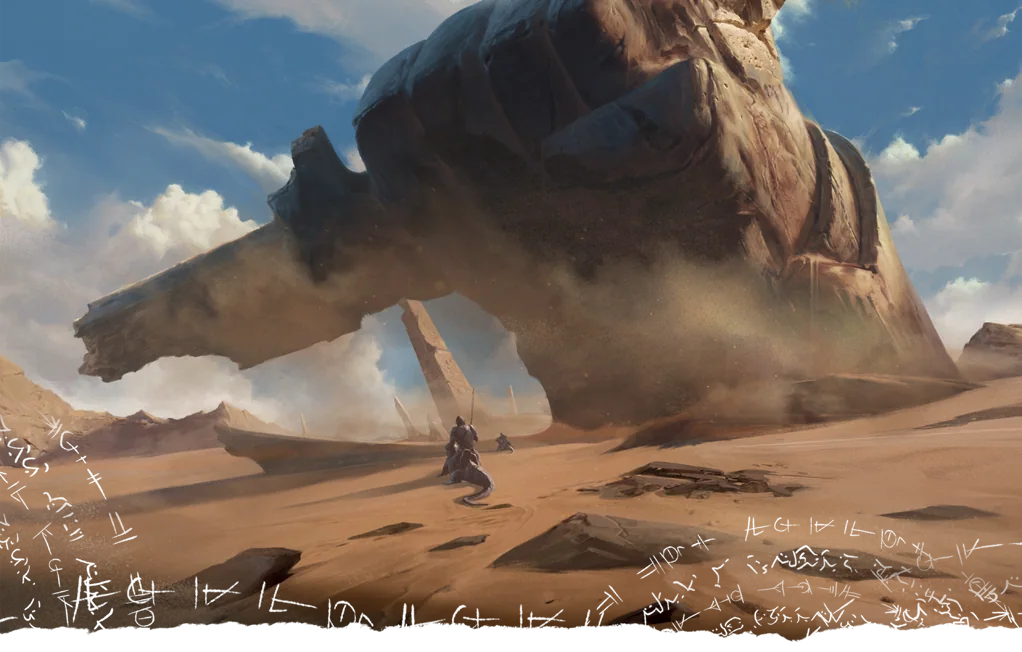
The Desolation was the catastrophe that ended the First Age of Teneris, an age of prosperity and learning that came to a sudden and sharp end. According to the records of the Church of Alarath, The Dark One somehow emerged from the Void and attacked Teneris. The attack, which threatened all of existence, was driven back by gods and mortals resisting together, but it brought the death of gods and of whole civilisations, the parting of the two continents by the Eye of Aquaron, and the covering of more than half of Caligran with a vile desert.1
It was the greatest cataclysm the realm had ever faced, and while it lasted it was easier to count the lost than the survivors.2 What exactly happened is still unknown: apart from religious texts there is no objective account, at least not in the Lands of Exile.1
The scar in the south
The Desolation began in the deserts of the south and swept across the entire continent.3 Most of Caligran is now covered with uninhabitable deserts and barren lands that appeared after it. These deserts are not the work of nature; they stand as a testament to the cost of defying the Dark One, and to the reward of still being able to draw breath.4
Everyone has heard of the disaster that drove all living beings into exile and migration, from children to priests, each according to their knowledge. Yet knowing the name "desolation" is not the same as understanding what it is. Beneath the desert sands lie great temples, built to hold back the Dark One's power and placed so that together they would form a protective seal.5
Flight and exile
The survivors fled north from the hunger of the sands and sought refuge among the humans of the lands now called the Lands of Exile, whom the disaster had not touched. This flight is the Exodus. The Order of Palanthor was founded to watch over the refugees and honour the promises of safety, and the surviving gods withdrew to the higher planes.1 Aquaron protected the fleeing elves, granting them sturdy ships and a calm sea.6
The Second Age began with the survivors mourning and struggling in a new, narrower and less advanced world, now governed by humans.1 All the elven races that survived the Desolation live in the Da’fat Federation.4 Before the Desolation every elf was immortal; afterwards all but Lady Nemarin and a handful of elders had lost their immortality. The druids of the Circle of Elders raised the Living Wall to stop the hungry desert that had consumed the south, an effort that saved the future of the whole continent.7 The High Elves are like a relic from before the Desolation.8
The gods
Many gods who existed before the Desolation have been erased from memory.9
Witnesses and heirs
Some sages had foreseen the inevitable, and the scale of the loss drove them to deep sorrow and anger. Before the Desolation took their lives, these sages, whose names are lost to history, performed a creative but perilous ritual to carry knowledge of history, magic, the natural sciences and religion past oblivion to later generations, at a grim price for themselves and for those generations.2
The bodies of the desolate Forgotten witnessed the Desolation, even if they do not remember it. Many others who share their fate still roam with hearts full of rage, and almost none of those know they are dead; the desolate Forgotten are aware of that truth.3
Towards the end of the Second Age the scholar Xeratos learned through prophecies that the Dark One would attack the world again and that a second Desolation was imminent.10
Life in the ruined desert
Before the Desolation, the elves and the creatures of the land lived in harmony, and in that time wyverns were tamed as mounts and beasts of burden; they shrank over time and came to be known as Uskans. When the Desolation struck, some of them held to their training, and most of those did not survive. Centuries in the desert have since made the Uskans resistant to heat.11
The Krivar trace their origin to elves who survived the destruction against all odds. Unable to find food, they tried to live on sand ants, but even the ants had been corrupted by the warping power of the Desolation. Fleeing the scorching heat underground, the elves slowly changed in body while their minds began to unravel.12
The Esurien Crones, believing that immortality could be gained by changing time, went south to the ruined deserts of the Desolation. No one knows exactly what happened to them there, but it did not go well.13
Mühürlü. Okumak için mührü kırın; oyununuzu bozabilir.
Notlar
- ↑KitapLands of Exile: Starter Setting Guide, p. 10
- ↑KitapBook of Dead, p. 14
- ↑KitapBook of Dead, p. 13
- ↑KitapLands of Exile: Starter Setting Guide, p. 2
- ↑KitapDesolation of Time, p. 7
- ↑KitapLands of Exile: Starter Setting Guide, p. 29
- ↑KitapLands of Exile: Starter Setting Guide, pp. 11, 43
- ↑KitapLands of Exile: Starter Setting Guide, p. 43
- ↑KitapLands of Exile: Starter Setting Guide, p. 21
- ↑KitapLands of Exile: Starter Setting Guide, p. 11
- ↑KitapDesolation of Time, p. 183
- ↑KitapDesolation of Time, p. 179
- ↑KitapDesolation of Time, p. 176
Kaynaklar
Bu madde şunlara dayanır:
Bu maddedeki görseller
 Desolation of Time (Bad Badger Games, 2024), p. 93. Art by the Bad Badger Games team.