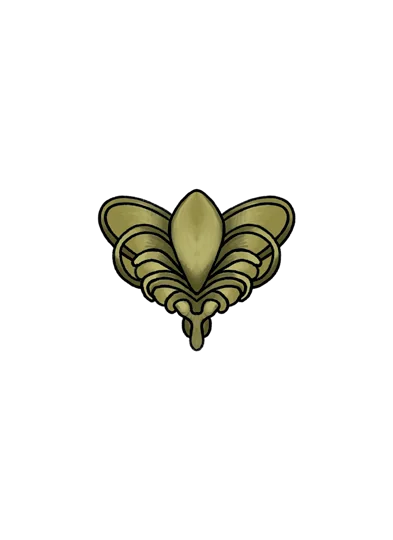
Dragon
Dragons are proud and cunning creatures. They rarely agree to help anyone without some show of reverence or wealth, and an attempt to bargain with one can end in greater demands or open hostility.1
Dragons and magic
Eidar is the raw magical energy left untamed by the goddess Zeolet.2 The pinnacle of its power is considered to be dragon magic.3
In the glow of dragon's breath, ancient smiths made legendary weapons and armour filled with the primal power of draconic might. The Rite of the Wyrmbrand Forge, a secret coveted by artisans, begins with a pact made with a dragon by negotiation or by force. The dragon breathes its flame over the forge while the smith shapes the piece, and ancient Draconic runes bind the dragon's essence into the metal, so that the runes glow faintly and the piece gives off heat. Something of the dragon lingers in such a work: the dragon stays bound to it and can sense its presence, and if the piece is not treated with the reverence the dragon believes it deserves, its resentment may one day fall upon the wielder.1
Dragon blood is toxic.4 Two books are devoted to dragons: the Wingborn Chronicles of Master Kaelor Vens, a detailed compendium of dragon species and their lore, and the Draconis Arcanum of Master Folden Kerst, which studies dragon-derived magic, the spells dragons cast and the use of dragon body parts in magic.5
Faith and rumour
Among the draconic gods, Praxaclas is the god of all dragonkin, with magic and honour as his domains and a dragon's head as his symbol.6
The scholars of the Order of Nus’ar held that Arcaneus, whom they called the "dragon of time", was the only true god, and many scholars believe that this dragon deity is in fact a manifestation of Orphus, the essence of time. The Empire and the Church have violently suppressed that belief.78
It is said that the Order of Palanthor holds two ancient dragon orbs. One, when used, is said to keep dragons from flying for miles around; the other, used up close, to lay an unbreakable charm on a dragon. At least, so the rumour goes.7
In the north
The lands of Fraza were once a hellish place full of dragons, giants and monsters. Ages ago the ancestors of the northerners tamed those lands with their courage, and their culture of monster hunting continues.9
After a successful dragon hunt, the half-giants and the Nordmen perform the Draklin Blot. The warrior to be blessed by the dragon's spirit sits inside a circle drawn with the dragon's blood, and a druid brings the slain dragon's heart into it. The warrior, called the blotnir, the gift receiver, eats three slices of the heart while the others sing the Hymn of Bravery, and then drinks dragon blood from a golden horn; the rite partly neutralises the blood's poison.4
Dragons of note
- Coralax, an ancient red dragon. About sixty years ago Duffrein Grimbolt of the Grimbolt Cripplers faced it head-on so that his companions could escape, and died in the battle.10
- Zher’kresk, a black dragon with goblin clans under it, which The Action Company vanquished.11
- An adult black dragon at the head of a goblin army, killed by Valakar and his companions; Valakar's skin soaked up its magical blood, which strengthened his powers.12
- Zherkses the Cruel, an adult black dragon who rules The Black Veil, one of the oldest assassins' guilds in the Empire, with an iron fist.13
- A green dragon wyrmling, slain by Aetheus Boldragon while he guided a noble wizard to the ruins of an elven tower. Its head hangs at his waist.14
Notes
- ↑BookBook of Dead, p. 111
- ↑BookBook of Dead, p. 37
- ↑BookLands of Exile: Starter Setting Guide, p. 19
- ↑BookBook of Dead, p. 103
- ↑BookLands of Exile: Starter Setting Guide, p. 49
- ↑BookLands of Exile: Starter Setting Guide, p. 32
- ↑BookLands of Exile: Starter Setting Guide, p. 41
- ↑BookBook of Dead, p. 35
- ↑BookLands of Exile: Starter Setting Guide, p. 43
- ↑BookMercenary Compendium, pp. 74, 161
- ↑BookMercenary Compendium, p. 84
- ↑BookMercenary Compendium, p. 144
- ↑BookMercenary Compendium, p. 166
- ↑BookMercenary Compendium, p. 18
Sources
This article draws on:
Related articles
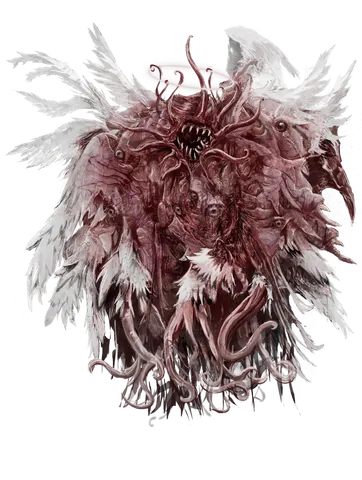 CreatureSinful AngelA grotesque abomination born when an attempt to summon an angel goes wrong and the angelic essence fuses with an impure human vessel. It wails in anguish, spreads dread, and perishes within a day of its emergence.
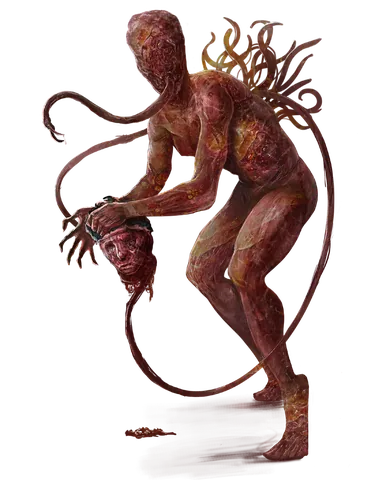 CreatureSkin StealerAn evil fey being born of a union between humans and dream walkers. It flays its victims, wears their skin and slowly takes on their memories, until it can perfectly copy their manner.CreatureDoppelgangerA shapechanger whose kind can be told apart from others, such as the werewolf, by the scent it gives off.CreatureHydraA monstrosity reported in the Crater of Mortenox, where the hunter Davos Fratz is seeking a way in to hunt it; a hydra also killed a noble's family as they swam in a lake.CreatureMusesBeings sought in vain by the bard Gazelle the Lamenter, who put massive bounties on their heads in his search for inspiration.CreaturePseudodragonA creature kept as a pet and companion, which its owners count as a great privilege.CreatureRestless WatcherA mindless, fiendish guard made from a humanoid corpse through an infernal binding, bound to protect one place against intruders. Many infernalists know the rite.CreatureSahuaginMonstrous creatures known from their raid on the town of Mossentry and from a perilous encounter on a voyage to the Islands of Farr.CreatureStorm GiantsGiants remembered in the legend of the weapon Wrath of the Storm, which is said to have ended a war against them.