
Miracles
Miracles are the wonders worked by priests, paladins and other chosen mortals. Together with Aether and Eidar, they are one of the three things one must understand to understand all magic.1
Nature
Miracles are not magic, at least not in the way scholars understand it. So-called "divine magic" draws its power neither from this realm nor from any force connected to it. It comes from the upper planes and takes shape by flowing through worthy mortals able to wield it; the will of the cleric forms a bridge between the upper planes and the physical world.2
The miracles of priests involve no magical incantations; they are made of prayers.2
The gods and the power
When priests or paladins perform miracles, they do not draw the power from the gods themselves. The bond they form reaches the upper planes where the gods exist, and the gods can sever, steer or guide that power. The force that comes from the heavens is therefore not necessarily the decree of a single god.2
Scholars argue about this without end, but those who perform miracles are surely chosen individuals. They often do not fully understand how they do it, for their hearts guide their hands, not their minds. When such a person has devoted themselves to a single god, as is often the case, their miracles take the shape of that god's personality and character.2
Priests and miracle workers
Not every priest is a miracle worker. The work of a priest is to serve a deity and that deity's faithful, which does not necessarily require miracles, and the power the gods invest in clerics and other miracle workers is given out very rarely. Some temples do not have a single priest able to perform one.3
If the clergy notice that someone carries the miracles of the gods, they will certainly want to bring that person into their church.4
Raising the dead
Teneris is a realm where magic and miracles are exceptionally rare, and finding a cleric with the power to bring someone back from the dead is a daunting task. Taking a soul from the grasp of Rakash is a risk not every mortal will run, for whoever does it will one day pass through the same gates and face him.4
A departed soul's journey from Teneris to The Gate takes about a minute; once that threshold is crossed, a return becomes far more complicated. A cleric able to perform the resurrection must be found, the approval of the High Church obtained, and unwanted guests who might latch onto the returning soul dealt with, and a price must be paid for all of it. Coming back from the dead is not easily within reach, even for the most powerful.4
Notes
Sources
This article draws on:
- SSGLands of Exile: Starter Setting Guide(Bad Badger Games, 2024), pp. 18-19, 22-23
Related articles
 OrganisationArchon AcademyThe largest and most powerful school of magic in the realm, set on a floating island above the Great Western Sea, which every mage in the Empire must attend and which serves as both university and prison.
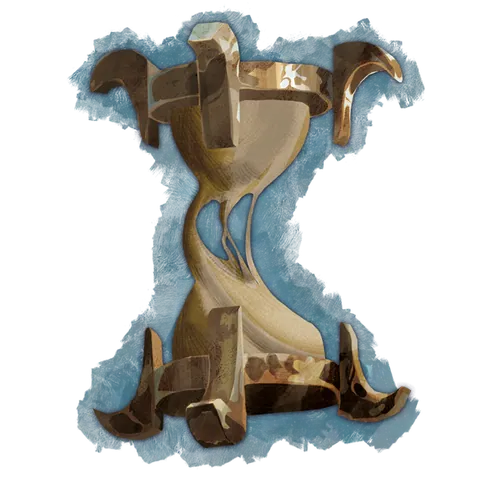 ArtifactGrand HourglassOne of the most mysterious objects in creation, the hourglass in which all the time in the universe gathers, entrusted by imperial doctrine to Arcaneus and bound up with the Hourglass Conspiracy of 261 AVD.ConceptThesis on Magic and the ElementsThe disputed second thesis that Castor defended for his mastery at the Archon in the Mürekkep ve Çelik campaign, arguing that all magic is the handling of matter and its elements rather than the shaping of energy.
 ArtifactBloodstoneAn extremely rare, mineral-like material of unpredictable power that mages prize for strengthening their magic, and that sometimes grows inside living beings as the dreaded Bloodstone Plague.ArtifactApparatus ImaginariumA wizard-made puzzle device, usually a puzzle box, that traps fey beings inside a demiplane shaped by its maker's imagination and can only be opened by solving its puzzle and final riddle.ArtifactComponent of Absolute CertaintyA crystal transformed by years of daily divination into a magical tool of foresight, usually bought from a magical institute or the black market, and used to drain the chaotic magic of captured fey.ConceptGalevan LawThe law discovered by Professor Maverick Galevan of the Coalition of Enlightenment and set out in his book Temporal Deteriorations of Spells, named after him.