Volkan
Volkan is the god of artisans, known as the Hammerhand, the First Blacksmith and the Shaper of Stones. His domains are creation, hardships, discipline and obstinacy, and his symbol is the hammer and anvil.1
He is also named the god of production, wealth and oaths, and like Rakash and other Greater Gods he is bound in his own way to the old rule of giving something in return for what one receives.2
The First Blacksmith
Volkan prizes craftsmanship, the artisan's skill and mastery of one's craft above all else. He lacks the power that other gods have to create from nothing, but he is supremely skilled at turning materials into new forms. He works every metal with ease, carves runes whose effects last for ages, and is the inventor of every known crafting technique.3
Volkan taught mortals the art of blacksmithing, and every weapon the gods wield was made by his hands.3
In iron we trust, with fire we rise.4
Volkan and the dwarves
The Dwarves believe, though the High Church rejects it, that it was Volkan who shaped them from stone. In their telling he places their lost souls in anvils and calls them back from the void with a whistle: he may not have made their souls, but he is the one who saves them from being lost. The nature and culture of the dwarves run parallel to his teachings.3
Worship
Contrary to popular belief, one need not be a dwarf to be a priest of the god of blacksmiths. Still, a human lifetime is short for producing masterpieces worthy of his name, and most of his priests do come from dwarven communities.3
To worship Volkan, the faithful meditate while drinking a specially brewed alcoholic drink, believing that in this meditation they will find the inspiration for their next great work. Those who are not craftspeople can worship him by giving raw materials freely to skilled artisans.4
The 2024 introduction to the setting adds that the inspiration does not always come, which is why artisans are usually given raw materials and money as an act of worship.5
Earlier name
In the 2017 introduction to the setting, the god of smiths is called Moradin; the name Volkan replaced it later. That account already describes him as the god who taught mortals smithing, worshipped above all by dwarves, his favourite people, and by smiths, and as the one who shaped the mountains and forged the core of the world.6
The 2017 account also tells of the hot, specially brewed drink and the meditation in which the faithful receive inspiration for their next weapon or armour, and links it to how well dwarves hold their drink. In that account he accepted only dwarves as his paladins and servants; elsewhere, by contrast, it is held that one need not be a dwarf to become his priest.73
In Sürgün Günlükleri
In the campaign Sürgün Günlükleri ("Exile Chronicles"), a dwarf official offers to bring the companions before the rune masters and ancient smiths of Gazad Fortress. These masters, he explains, give to those who prove worthy the holy objects they see in dreams sent from Mor.8
Notes
- ↑BookLands of Exile: Starter Setting Guide, pp. 25, 30
- ↑BookShadow Over Vansreik, p. 24
- ↑BookLands of Exile: Starter Setting Guide, p. 30
- ↑BookLands of Exile: Starter Setting Guide, p. 31
- ↑DesignerSürgün Toprakları Evreni Başlangıç Rehberi, 1:34:07, 1:34:15, 1:34:24
- ↑DesignerZincir Şarkısı Evren Tanıtımı #1, 1:06:22, 1:06:31, 1:06:33, 1:06:39, 1:06:48
- ↑DesignerZincir Şarkısı Evren Tanıtımı #1, 1:06:57, 1:06:59, 1:07:05, 1:07:09, 1:07:22
- ↑At the tableKhalaz Garud | DnD 5e Oynanış #33 (Sürgün Günlükleri #33), 3:24:43
Sources
This article draws on:
Books
- SSGLands of Exile: Starter Setting Guide(Bad Badger Games, 2024), pp. 25, 30-31
- SoVShadow Over Vansreik(Bad Badger Games, 2024), p. 24
▶ Actual play
- Khalaz Garud | DnD 5e Oynanış #33 (Sürgün Günlükleri #33), 3:24:43
Images in this article
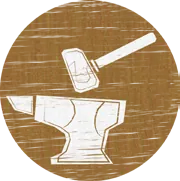 Lands of Exile: Starter Setting Guide (Bad Badger Games, 2024), p. 30. Art by the Bad Badger Games team.
Related articles
 DeityRakashThe god of death, the Gatekeeper, Heartless One and Reaper of Souls, who meets every soul at the Gate, guards the veil between realms and lets nothing that has passed return.
 DeityAlarathThe god of war and justice, patriarch of the Exiled Pantheon and protector of the Empire, who prizes courage above mercy and whose paladins are said to serve him even beyond death.
 DeityAmarathThe god of home and compassion, twin of Alarath, known as the Protector of the Weak, Mender of Wounds and Lord of Mercy, the god of all people to whom healers, families and villagers turn.
 DeityApatheThe goddess of broken fate and sole deity of the drow, the Mother of Spiders, the Seer and the Breaker of Promises, who foresaw the Desolation and led her elven followers underground.
 DeityAquaronThe god of sea and rivers, the Lord of Sea, First Shipmaker and Blue God, patron of sailors, who sheltered the fleeing elves and taught them seafaring.
 DeityKorhakThe god of strength and violence, prized by mountain tribes, marauder clans, orc warbands and mercenaries, whose creed holds that the strong should rule and that only a worthy fight earns his blessing.
 DeityMalacharThe god of luck and outcasts, the Lord of the Spinning Coin, the Smiling Fate and the Darkwing, who once spied on the Dark One for the gods and now shelters those whom society casts out.