Lands of Exile
Lands of Exile is the name scholars give to the lands that endured, by the grace of the gods or the resilience of mortals, after The Desolation. Humans lived in the north of Caligran long before the Desolation, but only after it were the wise, graceful, skilled and ancient races forced to seek refuge here.1 The history of these lands, and of Teneris as a whole, reaches back thousands of years.2
The Empire stands at the heart of the Lands of Exile, and the human race, which was here before all the others arrived, remains the greatest power in these lands.1
Origins
When the Desolation ended the First Age, its survivors travelled north to escape the hunger of the sands and came to the lands now called the Lands of Exile, seeking refuge among humans whom the disaster had not touched. This journey is called the Exodus, and the long-lived races arrived here only after it.2 At that time the lands were divided into five human kingdoms.3
As different cultures began to live side by side, the exchange of knowledge in culture, technology, the magical arts and philosophy among them shaped the course of the Lands of Exile.4 In the early Second Age, natural borders such as high mountains, impassable forests and mighty rivers rose between races that were in conflict. Some scholars credit the gods, Amarath among them, with using their power over nature to lessen the conflict; more sceptical scholars see the hand of the elves in these changes and suggest, without evidence, that the elves reshaped the geography and ways of life of the Lands of Exile.5
Life in the lands
The wilderness between cities is rugged and dangerous.1 Most people die without travelling far from where they were born. They know that other races exist but seldom meet them, except for adventurers, and unfounded myths circulate here as freely as real knowledge.6
Many people, especially the uneducated, do not know the name Teneris or that the continent they live on is called Caligran. Some who know a little more may have a vague idea of where the name Lands of Exile comes from, and know the Exodus as a story.6 Not everyone can read and write, and education almost always brings wealth.7
Poverty, racism, injustice, class divisions, violence and greed are part of life in these lands. Evil has real causes, and people are not simply divided into the morally black and white.6 Giving something in return for what one receives, even when the exchange is not fair or equal, is one of the oldest rules of these lands.8 Throughout the Lands of Exile coins are used as currency, in several denominations according to the worth of their metal.9
Two moons light the nights of the Lands of Exile.10
Magic and arms
The limits of magic are high and its effects can be great, but magic is incredibly rare in these lands. Even its most skilled practitioners see it as a dangerous and unstable art, magical objects are very scarce, and becoming a spellcaster brings great social, mystical and legal difficulties.6 Bringing someone back from the dead is far from ordinary here; it is almost always dangerous and rarely happens without complications.11
Firearms such as cannons, pistols and flintlock rifles exist, but they are rare and precious weapons seldom found in ordinary hands. Gunpowder is produced through alchemy and magic.6
The Archon Academy was isolated after the War of the Immortal Mages and placed on a vast floating landmass in the north-west of the Lands of Exile, above the Great Western Sea.12
Faith
Many races and cultures live together in the Lands of Exile, and almost every village holds slightly different local beliefs. Races whose roots reach beyond these lands, such as elves and dwarves, brought nuances of older beliefs with them, yet the whole population worships similar gods.13 Literacy is low, so religious knowledge is usually handed down from elders to the young, which often leads to misunderstandings about all but the major religious figures. Churches and temples take on the task of connecting complex, mysterious and powerful gods with ordinary people, though even they do not always agree among themselves.13
There are temples and shrines in every corner of the Lands of Exile; even border outposts, large estates and many large ships set aside a room as a shrine.14 Many hold that the Supreme Patriarch, who stands above the council of patriarchs, is the most powerful person in all the Lands of Exile, second only to the Emperor.15
Powers and peoples
The legions of the Empire are the foremost military force in the Lands of Exile, and many seeking well-paid work find it there.16 Alongside them operate numerous mercenary guilds, each with its own ways of doing business, preferred jobs, styles and philosophies, and many freelancers who work alone.17
A long and bloody conflict divides the orc tribes and the Fran people; orc raids and Fran attacks across the Lands of Exile have kept it going until it seems beyond solution.18 Among the dwarves of these lands, a surname ending in "beard" marks a noble bloodline.19
Notes
- ↑BookLands of Exile: Starter Setting Guide, p. 2
- ↑BookLands of Exile: Starter Setting Guide, p. 10
- ↑BookShadow Over Vansreik, p. 33
- ↑BookLands of Exile: Starter Setting Guide, pp. 10, 11
- ↑BookLands of Exile: Starter Setting Guide, p. 11
- ↑BookLands of Exile: Starter Setting Guide, p. 3
- ↑BookShadow Over Vansreik, p. 21
- ↑BookShadow Over Vansreik, p. 24
- ↑BookLands of Exile: Starter Setting Guide, p. 34
- ↑BookLands of Exile: Starter Setting Guide, p. 6
- ↑BookBook of Dead, p. 134
- ↑BookLands of Exile: Starter Setting Guide, p. 39
- ↑BookLands of Exile: Starter Setting Guide, p. 21
- ↑BookLands of Exile: Starter Setting Guide, p. 23
- ↑BookLands of Exile: Starter Setting Guide, p. 24
- ↑BookMercenary Compendium, p. 102
- ↑BookMercenary Compendium, p. 8
- ↑BookLands of Exile: Starter Setting Guide, p. 45
- ↑BookMercenary Compendium, p. 119
Sources
This article draws on:
In Lands of Exile
Related articles
 RegionThe EmpireThe human realm at the heart of the Lands of Exile, an absolute monarchy heavily shaped by faith, ruled from Marble City by the unbroken line of the Red Eagle and divided into five provinces under their Sovereigns.EventExodusThe flight north of the survivors of the Desolation, who escaped the hungry sands and sought refuge among the humans of the lands now called the Lands of Exile.
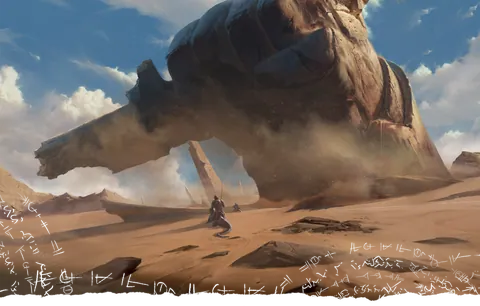 EventThe DesolationThe cataclysm that ended the First Age, when the Dark One attacked Teneris. Gods and whole civilisations died, the two continents were parted and more than half of Caligran became desert.RegionTenerisThe ancient world in which the Lands of Exile lie, with two great continents, Caligran in the east and Canarque in the west, divided by the Great Western Sea and the vortex called the Eye of Aquaron.EventSecond AgeThe long age that began when the gods withdrew after the Desolation and left the Priest-Kings to rule, and that ended with the rise of the Empire, a second threat from the Dark One averted, and the disappearance of Xeratos.RegionCaligranThe eastern of the two great continents of Teneris, mostly desert since the Desolation, whose habitable north holds the Lands of Exile, the refuge of the surviving races.
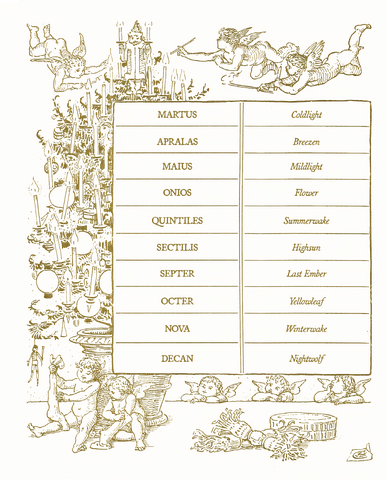 ConceptClora FastisThe formal calendar of the Empire, used by nearly everyone in Caligran, with ten months in a year of 304 days and years counted before and after Victory Day.RegionCanarqueThe western of the two great continents of Teneris, a collection of fragmented lands discovered by an imperial expedition that returned in 289 AVD, and known to most imperial subjects as the New World.RegionDa’fat FederationThe elven federation south of the Calinor-dal, founded in the Second Age by elven tribes who fled north after the Desolation; every surviving elven people lives there, and Lady Nemarin is its spiritual leader.RegionFrazaThe harsh northern realm beyond the Empire's mountain passes, a land of monsters and relentless winter whose clans live free, honour strength and deed above blood, and esteem their seers and witches.