Clora Fastis
The Clora Fastis is the formal calendar of The Empire. There are other ways to mark the passing of days, but nearly all the folk of Caligran have adopted it.1
Years and eras
The current system records every date in relation to Victory Day: an event falls either Before Victory Day (BVD) or After Victory Day (AVD). Many connoisseurs hold, for instance, that the master brewer Gruznar Barmbeard was born in 49 BVD; he delivered the first barrels of his golden Goldroot beer in 11 AVD.2
The Empire did not always use it. During the Third Age it had not yet adopted the Clora Fastis, and another calendar was in use, counted from the end of the Second Age and the founding of the chain wardens' fortresses. Histories now give the events of that age in the present reckoning to avoid confusion.3
Months
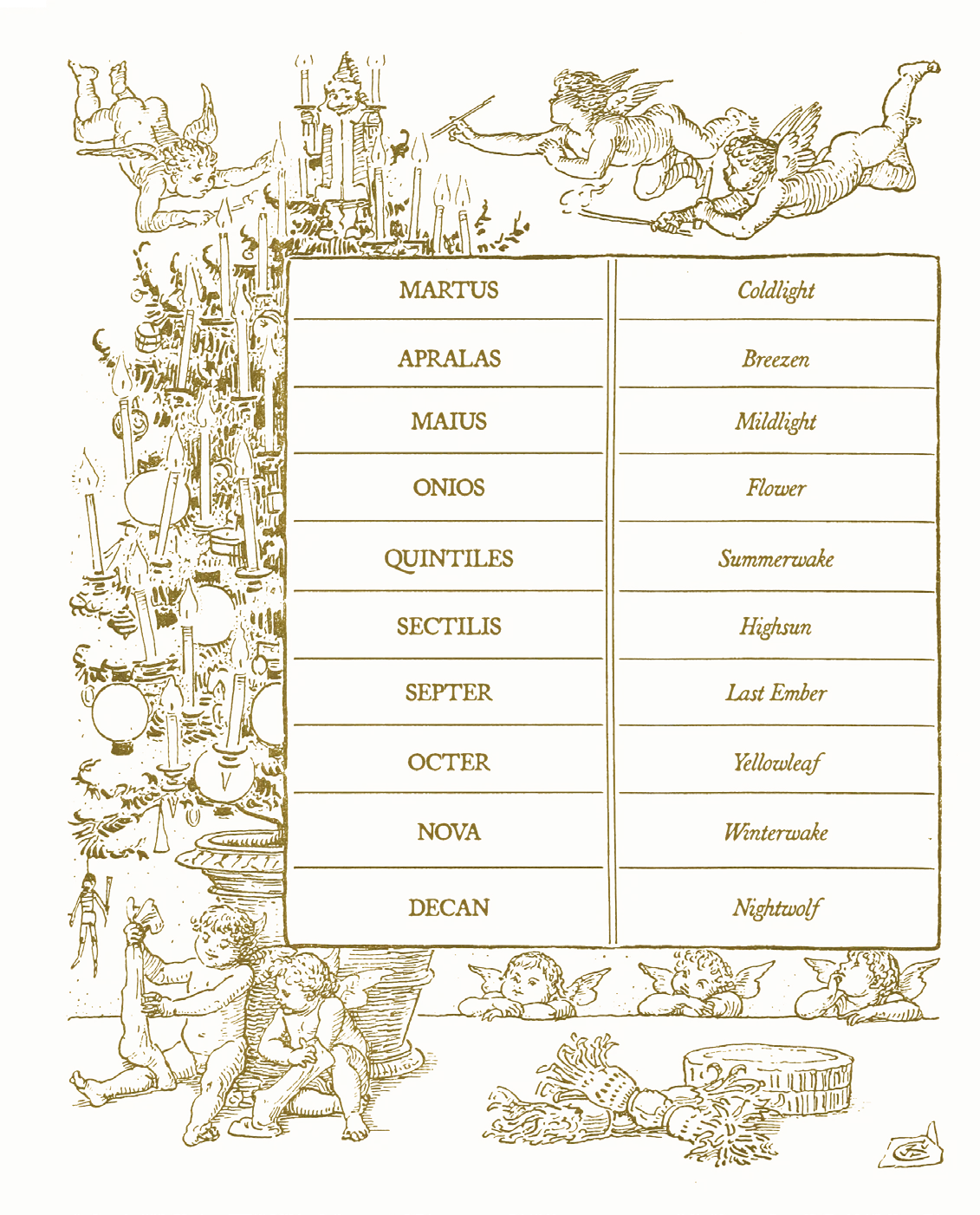
A year on Teneris has 304 days, divided into ten months of thirty or thirty-one days. Each month has a formal name and a common one.4
| Month | Common name | Days |
|---|---|---|
| Martus | Coldlight | 31 |
| Apralas | Breezen | 30 |
| Maius | Mildlight | 31 |
| Onios | Flower | 30 |
| Quintiles | Summerwake | 31 |
| Sectilis | Highsun | 30 |
| Septer | Last Ember | 30 |
| Octer | Yellowleaf | 31 |
| Nova | Winterwake | 30 |
| Decan | Nightwolf | 30 |
Tendays and Malachar's Day
Each month is made of three tendays, also called septi. The days have no names of their own and are simply counted from the start of the tenday, so the thirteenth of a month is "the third day of the second septi". Scribes write a date as a number and a month, such as "3 Martus" or "13 Sectilis", while most people place a day by its distance from today or from the nearest holiday.1
Hours and bells
Most people cannot read and know the time of day only roughly, as "mid-morning" or "late night". Mechanical clocks exist in the Empire, but clockmaking is an expensive art taught and practised by gnomish engineers, and only the wealthy can afford a clock. The Empire has just two clock towers, one in Marble City and one in Westreach. Where a temple or civic bell tolls the hours, people speak of "bells" and arrange to meet "at the 9th bell".2
Other calendars
- Wheel Calendar. The Northerners count days through the turning seasons, as in "the 35th day of the summer", and say "ten winters have passed" rather than "ten years". It suits the shamanic faith of the Fran people; for more detailed accounting most Northerners also know and use the Clora Fastis.1
- Year Tree. The elves read time as branching lines, measuring the span between significant events on a branch and the distance between related branches. Made for their immortal existence before the Exodus, it serves historiography more than timekeeping.1
- Ten Decade Calendar. Living underground, the Dwarves cannot follow the sun or the stars. They plant metal rods of precisely known decay in properly blended soil, one kind turning to dust in exactly a hundred years; temples measure days and hours with glowing gamgam stones, and ordinary folk use marked candles.5
- Twin-Moon Calendar. The orc tribes keep a calendar quite similar to the Clora Fastis, but their year begins on the day both moons appear in the sky together, and their day begins at night.5
The Inran and Geroni of Canarque use calendars entirely of their own, the people of the Farr Islands follow the tides, and the Ironborn track the days by magic.5
Special days
Every nation, culture and faith across Teneris has its own festivals and holidays. Their dates are usually governed by a celestial event, such as the cycles of the sun, the twin moons and the stars, and almost every land keeps festivals for the anniversaries of religious events, the changing of the seasons, local myths and long-lasting traditions.5
Among the special days of the calendar are the Night of the Red Moon, the Day of the Thousand Fangs, the spring and autumn harvest festivals, the Day of Swords, Saint Clarice Day and the elves' Cerulian Day.6
Notes
Sources
This article draws on:
- SSGLands of Exile: Starter Setting Guide(Bad Badger Games, 2024), pp. 4-7, 12
Images in this article
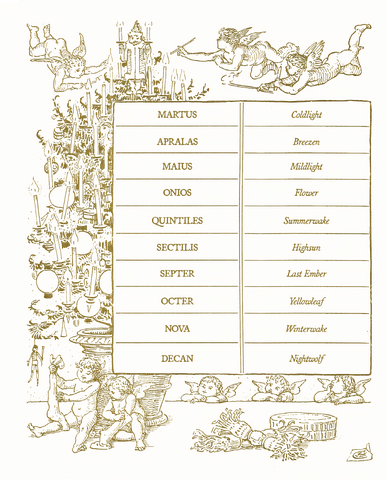 Lands of Exile: Starter Setting Guide (Bad Badger Games, 2024), p. 4. Art by the Bad Badger Games team.
Related articles
 ConceptMartusThe first month of the Clora Fastis, the imperial calendar, commonly called Coldlight. It has thirty-one days, the last of which is a Malachar's Day.ConceptSectilisThe sixth month of the Clora Fastis, the formal calendar of the Empire. Its common name is Highsun, and it has thirty days.ConceptApralasThe second month of the Clora Fastis, the imperial calendar, commonly called Breezen. It has thirty days.ConceptMaiusThe third month of the Clora Fastis, the imperial calendar, commonly called Mildlight. It has thirty-one days, the last of which is a Malachar's Day.RegionCaligranThe eastern of the two great continents of Teneris, mostly desert since the Desolation, whose habitable north holds the Lands of Exile, the refuge of the surviving races.
 RegionThe EmpireThe human realm at the heart of the Lands of Exile, an absolute monarchy heavily shaped by faith, ruled from Marble City by the unbroken line of the Red Eagle and divided into five provinces under their Sovereigns.RegionLands of ExileThe northern lands of Caligran where the ancient races took refuge after the Desolation, with the Empire at their heart, a harsh world of rare magic, scarce learning, many faiths and dangerous wilds.ConceptMalachar’s DayThe thirty-first day that follows the three tendays in certain months of the Clora Fastis, named in homage to the god of luck and surrounded by popular beliefs about time standing still.ConceptTen Decade CalendarThe calendar of the dwarves, who live underground and cannot track time by the sun or stars, and instead measure long periods with metal rods that decay at precisely known rates.